Monday, October 31, 2011

2-0-0

According to postings list on my blog, this is my 200th post.  It feels like a bit of an achievement and it's hard to believe that it's been so long since I came to Australia.  I've spent such a long time here that in many ways I consider myself Australian, although the Department of Immigration and Citizenship would disagree.  Still, even if I don't end up living in Australia permanently, I think Australia will always be alike a second home; perhaps sort of like a cottage, not where you live, but where you go to relax and have a fun time.  I wouldn't mind living here permanently, don't get me wrong, but bureaucracy is mighty fortress.

There have been a few interesting events in the last few days, my brother's birthday for one.  He's now 26 and almost in his late 20s.  He tells me he enjoyed the dinner mom, dad and he had so I guess it's another enjoyable birthday for him.

Yesterday was also the yearly Fenner Hall Valete Ball, a celebration of those who are graduating and/or moving out.  Since I was finishing my diploma this year I was entitled to attend and I received, like last year, a metal cup with Fenner Hall's crest engraved on it although it is smaller than last year's.  Interestingly, I was the first person called up.  The whole affair was quite formal and everyone was dressed in their best.  There were also awards to those who had made special contributions to Fenner Hall over the year.  I think everyone enjoyed it.

The big news out of Australia, though, is, of course, the grounding of the Flying Kangaroo, QANTAS.  The lockout has caused quite a stir and I can assure everyone that there is little else talked of in Australia.  The government's called in an arbitrator for mandatory talks between the parties so we'll see what comes out of that; I suspect probably a back to work order.  If this does go further, then the parties may have to resort to another great Australian innovation --- binding wage arbitration.  Apparently, the practice of having an arbiter decide wages during a dispute and having the decision enforceable at law was pioneered in Australia.  I think it's actually a very good idea, and it has been picked up the world over, so we'll see if it's played out in this little escapade.

Of course, Halloween is coming up too --- boo!  However, Halloween is really a Canadian/American thing and while there may be Halloween parties in Australia, no one goes trick-or-treating.  It's kind of a shame, really, as all those children miss out on free candy.  It also means that Australians have to put up with Christmas decorations in their stores from early October, so I think it's lose-lose all around.  If I could, I would import trick-or-treating into Australia and I think it would be a better country for it.

The next big thing is the Melbourne Cup, running on November 1st.  With its $6.2 million purse, this is the most lucrative horse race in Australia, possibly the world.  It stops the country and 80% of the population has a bet on the race. Some bets are small, only a dollar or two, but there are serious betters with far too much money on their hands who will lay out thousands of dollars.  As it is the premier race day of the year, all ACTTAB staff are working and I'll be close to home, the Hellenic Club in the city.  I've been told to brace for a long day as I start at 08:30 but it I'll pass the time by thinking about all the money I'll make.  And when I say the race stops the nation, I'm not really exaggerating.  When the race is run, everyone stops what they're doing and the day is a public holiday in the state of Victoria.  Most people take it as good fun but if you win, especially something like a trifecta, you are looking at a major return.

To all my Australian friends, good luck in the Cup and to all my Canadian friends, happy Halloween.

Wednesday, October 26, 2011

The Cup and Beyond

Over the last 6 weeks, the largest international event that New Zealand has ever hosted, possibly its largest even ever, was played out on the sports fields of some of New Zealand's finest cities.  The 2011 Rugby World Cup (RWC) saw 20 countries divided into 4 pools all hoping to hoist the Webb Ellis Cup.  The New Zealanders were particularly hopeful as the All Blacks, New Zealand's national team, was ranked the best in the world and had the possibility of capturing the championship since the first one in 1987.  Rugby is New Zealand's national sport and the Kiwis take great pride in their abilities.

I'm proud to say that Canada made a very good showing in the RWC this year.  Many Canadians wouldn't know, but Canada is the 2nd strongest rugby team in the Americas behind Argentina.  Canada was placed into Pool A which included Japan, Tonga, France and New Zealand --- a very tough draw.  The Canadians played very well, beating Tonga, tying Japan although losing to France and New Zealand, although those teams are some of the strongest in the world.  Although Canada did not advance to the playoffs, the Canucks hold the distinction of being the only team to score first against the All Blacks at the RWC.

The playoffs were very exciting, especially in Australia.  I watched as the Wallabies narrowly defeated the reigning champs, the South Africa Springboks and then face New Zealand in the semi-finals.  Australia lost and had to contend itself with beating Wales to take the bronze medal.  New Zealand defeated its opponents with relative ease and advanced to the final as heavy favourite against the France Les Bleus.

The championship game was a titanic struggle between two great nations of the sport.  The All Blacks performed one of their hakas, the Kapo o Pango (the other one is the more famous Ka Mate) and the French walked up to stare them down.  The game was very close and neither team seemed to be kicking well.  New Zealand scored the first try but failed to convert although they managed a penalty goal giving them an 8-0 lead.  Les Bleus retaliated within minutes and scored a try on a brilliant series of plays that left the All Blacks stunned.  After the conversion the score became 8-7.  Despite both teams trying valiantly neither could get any more points on the board and in this exciting game that went to the wire, the All Blacks were able to cling to the win.  You can rest assured that all of New Zealand was celebrating that night and probably still is.

I decided that I should get into the spirit of the tournament and I decided to buy myself some official team jerseys.  To that end, I got jerseys for Canada, Australia, New Zealand and South Africa.  The last 3 I got from the official RWC website but the Canadian one was a bit trickier.  The Canadian jersey was unavailable at the online store because, apparently, they had sold out of them.  To me, this was incredible given that the exposure to rugby Canadians get is fairly minimal.  However, it is a very nice jersey with red, white and black elements and embossed maple leaves.  Perhaps it is that jersey's aesthetic quality that made it so popular.  In the end, I got the Canadian jersey shipped in from the UK and I got the last one in my size, so I felt very fortunate.

Despite the fun of the RWC, there is a serious side still to my life Down Under.  After the utter joy of having the privilege of writing the Canadian Criminal Law and Procedure exam in October, I am now studying for the Foundations of Canadian Law and the Canadian Constitutional Law exams in my continuing quest to be qualified to practice law in Canada, should the need arise, and giving myself a stress-related illness.  Those exams are in January and I'll be writing them again in Sydney.  I've given myself 10 weeks to study plus 2 weeks to review, which I think will be enough given the similarities between Canadian and Australian constitutional law and what I already know.  I'll write the Canadian Administrative Law exam in May and hopefully, that will be the end of it.  Assuming I pass everything, it means that I will be qualified to practice law, subject to other regulations and applications, in Australia, Canada and New Zealand (thanks to the handy Trans-Tasman Mutual Recognition Agreement).

Earlier on there was also the annual ACTAFL Umpires' Association dinner.  This year, it was a bit more low key than usual but fun nonetheless.  There was some lawn bowling and a very good dinner afterwards.  It was good to recognize those who had made high achievements throughout the year and have some gentle, good-natured fun at everyone.

I am fairly rapidly coming to the conclusion of my graduate diploma which will mean that I shall soon be admitted as a lawyer in the ACT.  All I have to do is complete this placement at Legal Aid I'm doing at the moment.  Every Monday I go in, along with a few others, and over the course of 8 weeks we take part in different aspects of Legal Aid's work, like client interviews, domestic violence matters, civil tribunal matters and just about everything else too.  It's part of the practical component of the diploma and I am learning a great deal though it.  I had an excellent experience at the Commonwealth Department of Public Prosecutions where I spent 2 weeks in September.  I feel I've been exposed to so much of the law and I think these experiences will stand me in good stead.

My placement finishes in November meaning I'll have completed all components of my diploma.  I should be admitted to practice in early December and graduating about a week later.  It's all been leading up to this.  I'm a little excited and scared by what's to come.  It's the uncertainty of the future that I do not like but maybe, with a bit of luck, there'll be some certainty soon.

Monday, October 17, 2011

The Long Way Back

In the last couple of months, my blog has changed from its initial format.  It migrated from a being a sort of weekly update to me providing narratives of the days of the various adventures I had in the last few months.  Unfortunately that took a little more time than I thought but I am now in a position to start writing weekly updates again.

In the months that have gone by since I last provided a weekly update, much has changed in my life.  I've almost completed my GDLP and I expect to be admitted to practice in December.  That means I'll be a fully-fledged lawyer.  That in itself is frightening enough, not to mention the prospect of having to move out of Fenner Hall, find somewhere to live and find a more permanent job.  I've applied to several jobs in Darwin, one place in Alice Springs but I do have a very good chance of getting a job with a company here in Canberra.  We'll have to see where I end up but it's the uncertainty that I hate.

I've also written 1 of 4 exams to get a Certificate of Qualification from the Federation of Law Societies of Canada's National Committee for Accreditation (NCA).  Basically, once I pass those 4 exams it will mean that I have the same level of knowledge as a Canadian law school graduate.  The test I took was Canadian Criminal Law and Procedure and I wrote it at the College of Law in Sydney.  I had intended to write the Foundations of Canadian Law exam as well but due to a public holiday, they were unable to administer the exam and the NCA forbids writing exams on non-scheduled days.  I wrote that in early October so I don't expect to hear the results until about mid-December or early January.  I think I've done quite well, actually, but you never know with these things.  I've staggered the other 3 so that I'll write 2 in January and the final one in May.  With any luck, I'll have no trouble with them and if necessary, I'll be able to practice in Canada if I wanted to.

In August I took part in the International Cup for Australian rules football in Sydney.  This is a tournament where teams from several countries come together.  I officiated games of both the Canadian men's and women's teams.  The highlight, though, was officiating the curtain-raiser at ANZ Stadium, the venue for the 2000 Olympics.  This was a game between the USA and South Africa before a game of the Sydney Swans vs St. Kilda Saints.  I felt quite proud of my accomplishment and excited to be doing such an important game in front of quite a large number of people.  Afterwards, my umpire coach said he was impressed with how I handled myself.

In June and July I visited Canada on a sort of working holiday.  I worked for 4 weeks in a dad's friend's law firm as part of the practical legal training aspect of the GDLP.  I feel like I learned such a great deal during my time there.  I also had a great time visiting and catching up with people I know.  I even managed to get some soccer time with the Ukrainian team.

I guess that's about it in terms of my life in the last few months.  I expect to provide updates on a weekly basis as the year goes on.  It's been a long road getting back but I'm here now.

Monday, October 10, 2011

Another Great Journey -- One Last Day

The final morning of our trip was wonderfully sunny.  The sky was clear and blue and Akaroa took on a more inviting feel in the light.  As Isabella and I had only seen the town after dark we were pleasantly surprised by how quaint everything looked.  Although we had to leave for Christchurch fairly early, we took the time to take a stroll down the main street.  It wasn't very long, underlying the town's small population, but quite a pleasant little walk.  Having mostly packed the night before, Isabella and I made our way back to the hostel and drov towards Christchurch.

We wound our way up the mountain road that we had taken the evening before and were treated to some truly spectacular views.  Along the way, by a roadside coffeeshop, we pulled over and gazed at the valley before us.  We were up on one ridge and there was another set of mountains on the other side but between them, you could see an arm of the sea.  There were some sheep, lots of trees, but no houses.  You got the feeling that though close to civilization, the Banks Peninsula was still somewhat removed from it.  There is no denying, though, that the peninsula is one of New Zealand's most beautiful places.

After our quick stop, we continued on to Christchurch.  Akaroa is not that far away, only about 60 kilometers, but it takes some time to get there owing to the mountainous road and then you have to take some pretty busy suburban streets.  There was more traffic on them than usual because cars were still not allowed into the city center.  We drove cautiously around the Christchurch before getting to Main North Road.

Isabella would be continuing her excursions by bicycle in New Zealand and she needed to get north to Cheviot and then Kaikoura, and this was the principal route.  Bicycles are forbidden on the main highway north out of Christchurch for some 30 kilometers which necessitated Isabella taking the road.  We parked by a city park and loaded the bicycle.  Isabella was quite well prepared and in very short order was ready to proceed north.  We said our goodbyes and I watched as Isabella pedalled with all her strength towards Cheviot.

I turned the car around, filled it up and returned it to the rental agency.  Their van then drove me back to the airport where I boarded my plane and flew off.

I very much enjoyed this trip, both for the company and the fact that I saw places I never had or had not visited for quite some time.  It was good to get out of Canberra for a while and just relax, and I think everyone deserves a vacation every now and again.  I hope this is not the end of my great journeys and adventures and I look forward to many more in the future.  Who knows where my next adventure will be?


Friday, September 30, 2011

Another Great Journey -- The French Connection

This was our last full day in New Zealand and Isabella and I had to make it to Christchurch, or as near as possible.  I was flying out the next day and Isabella would be continuing her bicycle journey north form there.  She had a few weeks to reach Auckland and this would go quite some ways to helping her out.  Also, our adventures in the dark trying to get to Invercargill the night before meant we were a little apprehensive but this journey was set to be straight and along mostly major highways.

Isabella managed to get a reservation at a hostel in Akaroa, a small town on the Banks Peninsula just east of Christchurch.  It was near enough that it wouldn't take too long to get to Christchurch and this particular hostel had very good reviews.  We decided first, though to do some exploring of Dunedin.

The central part of Dunedin is a circular collection of streets called the Octagon.  Many of the oldest and most important buildings of the city are in this small area.  For relaxation there's even a little park in the middle transected by Princes and George Streets.  We first walked up to the statue of Robert Burns, the great Scottish poet.  As Dunedin was founded by Scots, in fact the whole of the southern South Island to Invercargill was colonized mostly by Scots, things Scottish have a sort of pride of place.  It was one of Robert Burns' nephews who was the first minister in the local Presbyterian church, I think.  It's a good landmark to use if you want to meet someone.  Across the road is the impressive Anglican Cathedral with it's towering spires and beside it is the Municipal Chambers building.  The Municipal Chambers is perhaps best known for its clock tower which gives it a distinctive look.

From there we took a short walk down Stuart Street to perhaps Dunedin's most famous landmark, the train station.  Built when Dunedin was the second largest city in the country and center of a gold rush, its design is in the Franco-Flemish style.  That might not mean much in itself but among British colonies that use of architecture makes it more or less unique.  It has this sort of ornate quality about it that just makes it unmistakable.  The actual foyer to wait for trains is pretty small and most of the rest of the building is offices and the New Zealand Sports Hall of Fame which is a bit anticlimactic, but the building itself is thoroughly enjoyable to look at.  Our next stop was the First Presbyterian Church not too far away which doesn't receive as much credit as the Anglican Cathedral or the train station but it is an excellent example of Scottish Gothic architecture.

Getting in our car, we then drove to the north of the city and drove up Baldwin Street.  This is, supposedly, the steepest street in the world and I can categorically say that it is quite the adventure to drive up it.  You have to use the lowest possible gear and as you drive up you are in constant terror that you will stall.  Once you reach the top, the only thing you can do is turn around and head down where you're  in constant fear that the car will get away from you.  Isabella got the whole drive on video and it's quite the experience if you like a bit of adventure.

Isabella and I decided that we wanted to try some Bluff oysters raw, or as near as possible.  The price in Dunedin was quite high but Isabella said she remembered cheaper prices in another town on the drive in.  We drove to Mosgiel, a town I mentioned earlier, and it is only 15 kilometers from Dunedin.  There we found some Bluff oysters for half the price they were selling in Dunedin and decided to see if they really were worth all the hype.  We sat down on a bench and I took the first one and instantly cringed.  It was far too salty to leave them in the brine so we drained the brine and shared the oysters.  I don't think they were particularly good and Isabella agreed that they tasted far better deep-fried than raw.

From Mosgiel we drove back through Dunedin and off to the north.  Our only stop long the way was the famous Moeraki Boulders.  These are a series of boulders on a beach that have been rounded off by the erosive action of the sea.  They are quite well-known but there weren't that many people around when Isabella and I went for a walk.  They were interesting and certainly set in a scenic coast of New Zealand.

We didn't linger long and then made for Akaroa with all necessary haste.  Progress wasn't as fast as I'd hoped but I suppose we did it in about the average time.  To get to Akaroa you turn off the main highway and then cut across top the highway for the Banks Peninsula.  As we drove the lonely highway to Akaroa the highway turned from flat to mountainous as we crested and troughed the peaks of the Banks Peninsula.  By the time we finally reached Akaroa, darkness had set in.

The connection between France and Scotland runs deep and it seems that New Zealand is no exception.  The town of Akaroa, which may be the South Island's first European settlement, was founded by the French.  Even today the street names have mostly French names and the name of our hostel was Bon Accord.  Although it was dark, Akaroa was a pleasant little town and is a bit of a tourist destination precisely because of its unique French heritage.  Our hostel was also very well apportioned and I think it could've even rated as a hotel.  I keep saying that the Kiwis know how to treat visitors.

As it was dark, I was worried we wouldn't be in time for dinner but the manager of the hostel managed to get us a reservation at a very nice restaurant; it is probably Akaroa's nicest.  Isabella and I got dressed for the occasion and walked to the restaurant.  It was small, crowded, lively and magnificent.  It was clearly a very popular place as it seemed that every visitor was there.  We felt fortunate as there were some people who were turned away because the place was simply too full.  It had such a great atmosphere and the food was fantastic too.  At the end, they gave us each about a shot of a homemade liqueur produced from the feijoa plant.  This is a type of sweet fruit that is grown in some quantity on the South Island.  Even though I'm a teetotaller, I found it quite tasty and an excellent end to the evening.  With the crowd thinning out, Isabella and I took a nighttime walk along Akaroa's principal street before returning to the hostel.

We were both a bit sad at the realization that we would be parting company tomorrow but glad of the adventure.  We talked a bit and prepacked what we need to before turning in for the night.  We had seen quite a good portion of the South Island, from its towering mountains to the cold sea.  All that was left now was the next morning.


Friday, September 23, 2011

Another Great Journey -- The Catlins

The south coast from Dunedin to Invercargill is quite ruggedly spectacular and has been given the name, The Catlins.  It is sparsely populated but has some very interesting things to see.  I'm trying to think of an equivalent place in North America but I can't; perhaps something like the south California coast if it were transported to the eastern seaboard.  At any rate, Isabella and I decided to try this area next.

Our first stop was actually at the semi-rural house of some people Isabella had met earlier in her travels.  They lived in a house on the hills overlooking Dunedin and the view of the city was very good.  Isabella's friend, whose name I now forget, lives a sort of bohemian existence with her partner.  There are 2 couples, I believe, and they share this one, reasonably big house.  As I mentioned it's just outside Dunedin and it didn't take us long to get there.  Isabella and her friend chatted for quite some time and I joined in when I could and we stayed about an hour, maybe.  Afterwards, we drove back through Dunedin and to the south towards the Catlins.

To get to the Catlins you have to drive along the main highway before turning off at Balclutha.  I remember there being quite a lot of construction on the roads which made them rough and slowed down traffic.  I don't know if this was because of the earthquake a little while before or if it was simply seasonal work that had to be done.  We eventually reached the turnoff and headed down the road network known as the Southern Scenic Route.  This is not a major highway, you have to understand, but country roads.  There was still a fair bit of traffic but you could tell that the Catlins, while certainly well-visited, were probably often overlooked by travellers who merely wished to get to Invercargill or Dunedin.

Our first stop was Kaka Point where, like Sandfly Bay the day before, we took to hiding behind a blind to see hoihos.  There were a few in the grass on the hills.  It seems that hoihos go to great lengths to set their nests in the grass where the eggs will be safer from predators.

Our next stop was nearby Nugget Point with its famous lighthouse.  Here there were quite a number of people milling about and it seemed to be one of the more popular spots.  It was a bit of a walk from the parking lot to the actual lighthouse but the view from was quite lovely.  The  The coastline on either side of the lighthouse is quite rugged and has no doubt claimed many vessels in its time.  The day had been quite sunny up to this point but as we left Nugget Point, the clouds were truly coming and it was clear we would be in for some wet weather.  This is not unexpected and this part of the South Island is prone to such changes as there really is nothing between it and Antarctica so cold, wet weather is a feature of existence here.

From Nugget Point we drove to Purakaunui Falls, a smallish waterfall in the area.  The roads to the falls were paved but mostly through woods and I don't recall there being any other cars really.  We made it to the falls, parked the car and walked down.  The falls were quite nice, a series of cascades in the forest but nothing truly spectacular.

From there we drove to Niagara Falls.  This drive took us along some very hilly terrain but it did offer some great views of the area.  We had noticed the name on one of the maps we had and decided to check it out as our Canadian heritage impelled us.  Niagara Falls, in this case, is a small rapid and the person who named them after the famous North American falls did so expressly out of irony.

From Niagara Falls we drove along the coast to Curio Bay which has a famous petrified forest.  The rain was coming down hard now and reminded me of the last time I was in Invercargill.  The petrified forest sits on a sort of rocky shelf right on the ocean and you can step out onto it.  Although it was raining quite hard, I decided to take a walk on the rocks.  At various points you could see what were once trees and they had now hardened to solid rock.  It was actually quite informative and there were 2 volunteer conservation officers who explained various things.

Our last stop for the day was Slope Point, the South Island's southernmost point, and here were truly alone. There not another car on the whole road there and when Isabella and I exited, there was hardly a sound.  The walk down to the point goes through a farmer's field but I imagine there is a public right of way, at least, no one came out and told us to get off their land.  Slope Point itself is just a rocky outcrop that juts into the sea.  I went right to the edge and thought that this was the last point of land between here and the Antarctic ice, over 4 000 kilometers away.  From Slope Point though, in the distance, through the sun's rays, you could just make out Rakiura (Stewart Island) and the rugged coastline extending to Invercargill.

Isabella and I climbed back into the car for the trip back and this is where the harrowing part of our journey began.  We made it to the village of Fortrose which marks the end of the Catlins.  I had intended to skip Invercargill altogether and simply head north towards Edendale where we could meet up with Highway 1, the principal route in the south part.  I noticed we were a little low on gas but  decided to press on and fill in Edendale.  Unfortunately as we followed the signs to Edendale we were going through back country roads that while paved, had few settlements about them.  Luckily there were signs to Edendale until we hit a crossroads and the sign only pointed to Wyndham.  I decided to turn in the opposite direction, which turned out to be a mistake.  I later saw on Google Street View that I should've turned towards Wyndham and we would've reached Edendale quite quickly.

As it was , our current situation was that we were lost along country roads, low on fuel, in the dead of night, but heading towards Invercargill. We could only hope that we would reach that city before our fuel ran out.  As it turned out, after making our way long these country roads and through back streets, we reached Invercargill and found a gas station.  I apologized to Isabella as profusely as I could for our situation but promised to make up for it by taking here to the Lone Star, a steakhouse my brother and I had gone to when we were in Invercargill.  Luckily it was still open and we had a very good meal, including some wonderful deep-fried Bluff oysters.  These oysters are farmed in Bluff, only 30 kilometers to the south and are known for their taste.  I who generally am apprehensive of seafood had a taste and they appealed to me.

After this rather late dinner, I took Isabella to Invercargill's famous water tower.  It was lit up and we drove around it.  After getting a little lost in the city we managed to find our way back onto the principal highway and raced back towards Dunedin, which is only 200 and a bit kilometers away.  Isabella slept most of the way for which I cannot blame her.  We passed through some towns and villages but all over there was quite and very few other cars on the road.  With so little traffic it was easy to make it to Dunedin and when we finally reached our hostel, we crawled up and fell asleep as soon as we could.


Tuesday, September 20, 2011

Another Great Journey -- The Otago Peninsula

Instead of just hanging around Dunedin all day, Isabella and I decided to take in some sights around Dunedin.  Luckily, Dunedin has a very picturesque area within easy driving distance --- the Otago Peninsula.  This is a large spit of land that just out of the South Island and Dunedin is situated where the peninsula meets the mainland.  The Otago Peninsula has some remarkable things to see and we were determined to see as many as we could.

The first place we stopped was Taiaroa Head at the eastern edge of the peninsula.  This place is known for having the only mainland breeding colony of Royal Albatrosses in the world.  There is a visitors center that leads to a walk to an observation platform above the breeding colony.  Isabella and I stepped in, saw the prices and decided to step out again.  It was quite expensive for short viewing and there were no discounts for students or anything.  Isabella and I decided to drive up a side road to get some better views of the surrounding area and the panorama was exquisite.  Sunny days do not often happen in Dunedin and the sun provided excellent light for the views.  Isabella and I also had some lunch on the grass near Taiaroa Head, looking out over the Pacific Ocean.

At this point I figured that since we'd come this far, why not at least check out the colony.  I went inside and bought the necessary tickets.  I tried to get Isabella a discount as she is a conservation officer in Alberta but the staff declined.  Before the tour began Isabella and I looked around the visitors center which had many displays regarding the habits of albatrosses, the establishment of this particular colony and its subsequent protected status.  From there the tour group marched up to the observation platform.  There was only 1 albatross flying around and I didn't see any others in the thicket but an albatross is flight is quite an impressive sight to behold.  The wingspan is enormous but even the Royal Albatrosses wingspan is less than that of the Wandering Albatross, which can be up to 3 meters.  An albatross doesn't actually use and energy when it glides because it has a tendon that locks the wings in place.  They really are fascinating birds.

From the albatross colony, Isabella and I drove along the ridge of the Otago Peninsula to Larnach Castle, New Zealand's only castle.  It was built by a businessman and Member of Parliament who made his fortune in New Zealand and decided to build a home for his family in the Scottish style.  He found a beautiful spot atop the peninsula and set about having the structure built.  Mr. Larnach also made sure that the grounds were well ornamented with gardens.  However, the story of Larnach Castle is not a happy one.  Eventually, Mr. Larnach committed suicide and the children began fighting over the estate.  While Larnach Castle in its heyday had seen fantastic balls and functions, it eventually fell into decline.  The current owners bought it in the 1960s and it was in dire need of repair.  I'm sure that they got it for a steal and all I can say it has probably reaped dividends for them.

Larnach Castle, now fully restored, is a high end hotel and museum.  It's probably the most expensive hotel in the Dunedin area but people pay a fortune to stay here regardless.  It has a sort of charm about it and the views are undeniable spectacular.  The grounds contain gardens which are divided into several sections, each with different flora.  The inside of the castle, where photographs are not allowed, contains memorabilia from Larnach Castle's history and the rooms are preserved as they were.  The master bedroom had quite a nice view of the mainland on the other side.  However, my favourite place was the turret.  From there, there was an unobstructed view of the whole surrounding area.

You don't have to a be a guest of Larnach Castle to visit it, though you will have to leave by a certain time.  However, if you do want to visit the castle just as a visitor, be prepared to pay quite a substantial amount for the privilege.  It seems everything on the Otago Peninsula is expensive.

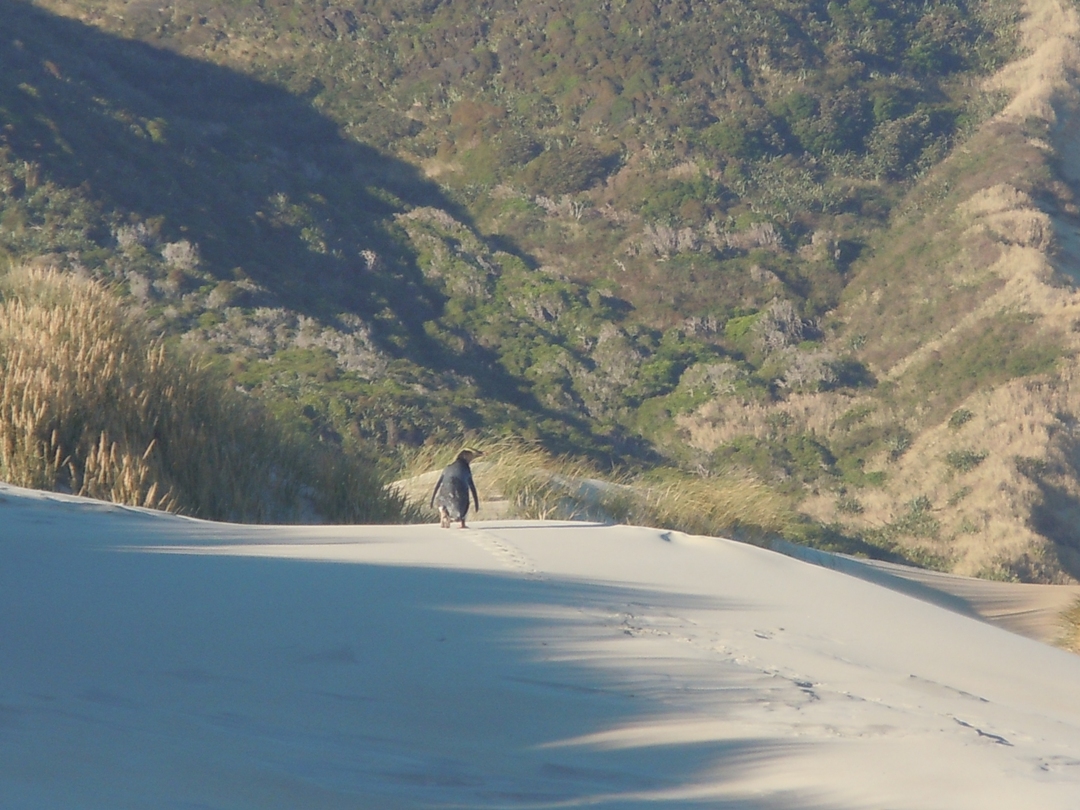
Our trip through Larnach Castle took us until the early evening so we decided to see some wildlife in Sandfly Bay.  This is a reasonable large bay on the peninsula's southwest.  It is one of the homes of the hoiho, the yellow-eyed penguin.  We drove to the parking lot and then walked the length of the beach to the blind to observe the penguins.  Along the way, Isabella and I observed many sea lions lying about in the sand.  They didn't become active until we were leaving so I guess they are mostly active at dusk and dawn.  We also saw a little hoiho walking along the sand dunes.  Once we reached the blind we were greeted by a volunteer conservation officer who explained where the hoihos like to make their nests.  He lent us a pair of binoculars and we observed some in the tall grass in the hills surrounding the bay.  These are quite sheer and I find it hard to imagine that a penguin could have climbed the distance.  It seems that they are tenacious little devils and simply hop as necessary.  After a solid viewing session, we hiked back to the car and drove towards Dunedin.

On the way back we took the high road along the peninsula's ridge.  Fog is a very common feature of the area and it was rolling in as we drove back.  It was a sort of fast moving fog that rolled and curled like smoke.  Once we were in the lower areas, though, the fog lifted and we could continue unimpeded.

Our Otago peninsula adventure was fantastic as we saw so much of what the area has to offer.  I hope to go back one day and, if I have a little more money, I'll stay at least one night at the castle.  The next adventure Isabella and I had was also very interesting, but at one point became quite harrowing.


Thursday, September 15, 2011

Another Great Journey -- From the Highlands to the Sea

With the morning sun, Isabella and I set out for Dunedin from Queenstown.  First, however, I wanted to show Isabella and excellent view up Lake Wakatipu north to Glenorchy.  I first laid eyes on it in 2005 on a trip to go horseback riding in Glenorchy.  That day was sunny and virtually cloudless which gave a magnificent view of the Lake and the mountains behind.  This day was a little cloudy which obstructed the view but did give the lake a sort of mottled blue and green surface.

From Queenstown we headed east on the highway to Dunedin.  We decided that since we had virtually the whole day to get there we would take the scenic route through the Otago Highlands, a mountainous area filled with grasslands and tors.  Our first stop, though, was Kawarau Gorge with its famous bridge, the birthplace of bungee jumping.  When we got there there were many people, mostly foreigners I gathered and some were taking the plunge from the bridge to the river far below.  I'm told that you choose the length of rope you want and you can either skim the river's surface or go for some form of immersion.  But you can't do it on a whim as the price is a hefty NZ$180, which is a bit expensive in my opinion.  However, to those who need the adrenaline rush, I'm sure it's money well spent.

Not too far away we stopped in a little highway fruit shop and Isabella picked out a huge quantity of greengage plums.  These are plums, as the name suggests, but they have a sort of green and purple skin that makes one think they are unripe.  I was a little apprehensive at trying them but once I did I immediately enjoyed them.  Greenage plums are small but very sweet, despite their appearance.  Isabella bout a box of about 50 or 60 for about NZ$4, I think, which was a steal.  They were a source of nourishment for many days afterwards and in hindsight the choice was inspired.  I went mad trying to find them in Australia but couldn't.

A little further on was a set of rapids called Roaring Meg, apparently named after a boisterous pub owner during the days of the local gold rush.  As we drove on we eventually reached Cromwell, the center of the South Island's fruit growing area and if there was any doubt about that there is a large statue of fruit outside town.  From Cromwell we passed through the likeable towns of Clyde and Alexandra before turning north onto Highway 85.  Here the landscape became grassy with many rocky tors punctuating the landscape and there was a very real sense of isolation.  There were few other vehicles on the road, though we did pull over on one occasion to let cattle pass.  It kid of highlighted the rural way of life, that cattle were droved along the major highway without any real impediment.

The next town was Ranfurly, which at one point had served as an important stop when the railway ran through this part of the highlands.  The railway has since been torn up but the old train station serves as a museum so Isabella and I decided to stop in.  Inside there were various relics and photographs of bygone days and we were invited to watch a video on the railroad's history.  I don't exactly remember why, but the video was just awful.  I think it had been produced about 20 years ago and had terrible music and was quite boring.  Isabella and I stayed as long as we thought we were being watched and then made a hasty retreat.

From Ranfurly, it was only a short drive to the Highway 87 turnoff which took us south towards Dunedin.  For its whole length there were virtually no towns except for Middlemarch and that only just deserves the name as it is so small.  Middlemarch, however, does have the distinction of being the end of the Taieri Gorge Railway, a rail line that runs from Dunedin along the scenic Taeri Gorge but is for tourism really.  From Middlemarch begins the Otago Central Trail, a walking trail that used to be the rail line.  However, at length, we reached Mosgiel, Dunedin's primary suburb and then drove into Dunedin.

We were booked in for 3 nights at Chalet Backpackers, which we found quite enjoyable.  One thing I will compliment New Zealand on is its excellent quality of hostels.  Dunedin would serve as our base for the next few days and we were going to make the most of our time there, seeing some of the city, but also some of the intriguing surrounding areas.


Monday, September 12, 2011

Another Great Journey -- Just Getting There

As I alluded to in my previous post, Isabella and I had one more adventure together before she returned to Canada.  Isabella decided to take a 2.5 month bicycle tour of New Zealand and we decided to meet in New Zealand a little before she left.  She had many adventures in New Zealand herself, some of great excitement, other harrowing.  Nevertheless, we decided that the best place to meet would be in Queenstown, the South Island's Mecca of Adventure.  I managed to find some time, almost a week, where there was a break in my studies and I could afford to take some time off.  However, just getting to New Zealand proved to be an adventure in itself.

For a while it looked like I mightn't be able to go on the trip for reasons beyond my control.  The story goes like this.  In order to stay in Australia I had to apply for a new visa.  I sent out the necessary paperwork by express courier one week before my visa expired, assured by the Department of Immigration and Citizenship (DIAC) that it would be enough time to have receipt acknowledged.  Under the Australian system, once you apply for a visa you receive what's called a Bridging Visa, a sort of visa that says you've validly applied for a substantive visa and that you're legally in the country.  It's not an assessment of whether or not your application will succeed, but it says that on the face of it, your application is valid.  Well, as the days went by and my student visa was about to expire, I still had no acknowledgement or bridging visa.

Then, in the early hours of March 16th my student visa expired and I was technically illegally in the country as I had no bridging visa.  I went to the DIAC office as soon as it opened and they communicated with the Adelaide office where I'd sent my application and the policy branch in Canberra to see how to deal with the situation.  Luckily, I had copies of all the documents I'd sent to DIAC as well as a computer printout from Australia Post that showed the documents had been delivered and signed for.  Unfortunately, the Adelaide office said that they would not specifically look for mine so I was left in a little bit of a jam.

Now, you have to understand that there are 5 types of bridging visas in Australia, A-E.  I needed a Bridging Visa B to let me travel to New Zealand but that was only possible if I were given a Bridging Visa A, which is the bridging visa they give you following receipt of your application but since Adelaide was unwilling to look for it, I wasn't going to get it.  This was problematic as I'd already booked the flights and the rental car, some of which was non-refundable.  That day, after being technically an unlawful non-citizen, as the law puts it, I was given a Bridging Visa E which let me stay legally in the country.  I decided not to try to put off the trip just in case Adelaide cam through.  Then, 3 days before I was to fly off, the acknowledgement came through, along with the Bridging Visa A and I raced down to the DIAC office to get my Bridging Visa B.  Luck was with me this time and I was able to fly off without further incident.  But I'll tell you, I was uneasy until I finally cleared New Zealand Customs in Christchurch.

Finally in New Zealand, I proceeded to the rental agency where I'd rented a car.  I was driven there from the airport and the driver and I talked about Christchurch's recent earthquake.  The damage was more considerable than I had thought and he said it would take years for the city to recover, if it ever really does.  A little shocked by this, I proceeded to take charge of my vehicle and headed out on the drive to Queenstown.

The Christchurch-to-Queenstown drive is one of the most scenic in New Zealand.  Once you take the turnoff to Geraldine, the traffic thins out and you're on some pretty lonely stretches of road, though quite beautiful.  The highway to Queenstown runs into the central highlands and offers great views of the Southern Alps.  There are also Lake Tekapo and Lake Pukaki, at the end of which is Aoraki/Mt. Cook, New Zealand's highest peak.  The interior is also mainly grasslands as the early Maori burned the trees hunting for the now extinct moa, a large flightless bird.  As I drove on towards Queenstown the sun set behind the mountains and before long all was dark.  I was not the only person on the road but at various times, it felt like I was the only person in the world.

After several hours of driving I finally reached Queenstown and met up with Isabella.  We stayed at a hostel she had picked out and she was quite glad to be driven around for a few days.  It seems that the day before she came to Queenstown, the weather on the South Island's west coast had turned ferocious, as it is often want to do, so she took a bus down.  Even still, the winds were howling and the rain torrential such that even the bus swayed on the road.  At any rate, we were happy to see each other and glad that nothing like that was predicted to happen in our time.

We walked around the town a little bit as it was night and had a pleasant dinner at a pub; it seemed to be one of the only things open.  But you have to understand that Queenstown is Adventuretown and as such attracts the young like penguins to microwaves so there were plenty of nightclubs just opening up.  We went to another hostel where we met up with a guy Isabella had acquainted and he took us to one of the nightclubs but we didn't stay long.  I dare say we were both exhausted from our travels and were looking forward to some sleep.  After our brief nightclub visit, Isabella and I returned to the hostel and turned in for the night, ready for our next series of adventures.


Friday, August 26, 2011

The Greatest Journey -- The Last Steps

Having covered such a large expanse of Australia, it was welcome pleasure not to have a long drive ahead. Canberra to Sydney is only less than 3 hours and there isn't much to see along the way, although a few points of interest there are. This was Isabella's last full day in Australia as she flew out to New Zealand to begin a magnificent bicycle tour. This would also be our last couchsurf experience and we would be staying with a young German man named Julien Mueller in his apartment in Sydney.

On the way out of Canberra, we stopped at the Weerewa Lookout over Lake George. Lake George is a very ephemeral lake that fills and drains depending on the climate. In drought, it is empty but in the recent past there has been enough water to reach the highway. With the recent rains, Lake George's southern end was filled with water and ACTEWAGL, Canberra's water and electricity provider, had built some large wind turbines on the far shore. There's still water in it today, probably more than in January and I hope that I get to see it full one day.

From Lake George we drove to Goulburn, Australia's oldest inland town, or so it claims. The thing Goulburn is noted for is the Big Merino, a large merino ram constructed out of concrete. In keeping with our tradition of stopping at large things, Isabella and I got out and took a photo of it.

From there it was on to Sydney and although we got a little lost along the way, we eventually found our host's home, a small thing on a side street but very pleasant. It turned out that our host sang in a band called Julien Mueller and the Full House and they would be singing at Darling Harbour that evening. They specialize in sort of Frank Sinatra-type songs. Deciding that it would be worth a look, Isabella, myself and another couchsurfer went down to Darling Harbour to check it out.

Darling Harbour is quite an active place. There you find the Powerhouse Museum, the Sydney Aquarium, the Maritime Museum, an Imax theater and a sizeable shopping center. We arrived in the evening and there were many people there. The big attraction, though, was the buskers who plied their craft wherever you walked; some were better than others. Eventually Julien and his band got going and I must say they were very good. I was impressed with the quality of the musicians and Julien's voice. Quite a crowd gathered in the sort of amphitheater created by the semicircular steps. By the end of the show, several people had bought the band's CD, including Isabella, and I think it was not out of pity but out of genuine admiration.

By the time we got back to Julien's it was quite late and Isabella had a plane to catch in the morning. We were all too tired for any sort of farewell ceremony so we just sort of lay down and nodded off to sleep. I was sad that the adventure was over but glad that I'd had an opportunity to travel the country with someone and to see some unusual and not often visited places.

I drove Isabella to the airport in the morning and bid her fair winds on her upcoming adventure. Isabella had decided to take a 2.5 month bicycle tour around New Zealand so she was off to Auckland. As she flew off, I was on my way back to Canberra. Returning the vehicle I calculated that I had driven exactly 10 700 kilometers in the month or so Isabella and I had been around Australia, an average of over 400 kilometers a day. Taking into account that I drove the Canberra-Sydney route twice alone, I think we covered roughly 10 200 kilometers together, not a bad sum.

Although Isabella and I had finished this adventure, there was still one more to come.